If you’re watching the market in the Chicagoland suburbs, one question comes up consistently:
Where are home prices right now—and what does that mean for me?
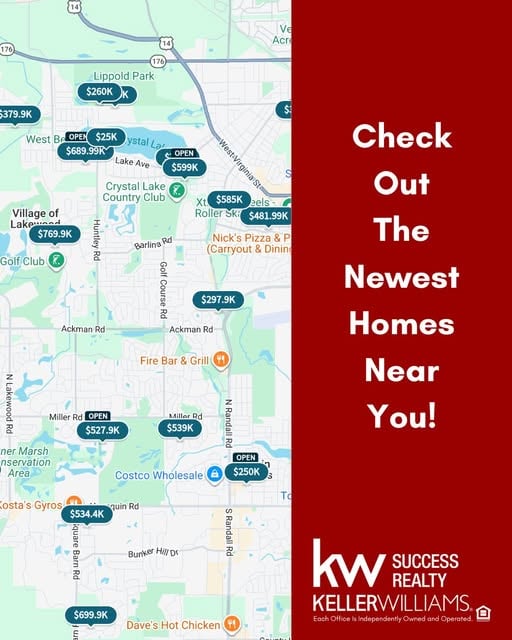
The visual you’re seeing highlights the median listing price across our suburban market. It’s a useful benchmark—but understanding how to interpret it is where real strategy begins.
What the Median Listing Price Actually Shows
The median listing price is the midpoint of all active listings—half of homes are priced above it, and half below.
In suburban markets, this metric helps:
- Establish a baseline for pricing expectations
- Identify general market direction
- Highlight shifts in buyer demand and inventory levels
But it does not tell the full story—especially in a region as diverse as the Chicagoland suburbs.
Why Suburban Markets Vary So Much
Not all suburbs move the same—and in many cases, not even close.
Markets like Barrington and Inverness often command higher price points due to lot size, privacy, and luxury inventory.
Meanwhile, areas like Hoffman Estates, Schaumburg, and Palatine may offer more varied pricing ranges, attracting a broader pool of buyers.
Further west, communities like Batavia and Naperville bring a mix of newer construction, established neighborhoods, and strong school districts—all of which influence pricing differently.
Even within the same suburb, pricing can vary significantly based on:
- Neighborhood and school district boundaries
- Lot size and setting (cul-de-sac, backing to preserve, etc.)
- Updates, condition, and architectural style
- Inventory levels at that specific price point
What This Means for Sellers
If you're preparing to sell in the suburbs, the median price is only a reference point—not a pricing strategy.
Today’s market rewards:
- Precision pricing based on real-time comparable data
- Elevated presentation that differentiates your home
- Strategic timing to align with buyer activity
In many suburban markets right now, properly positioned homes are still attracting strong interest—especially when inventory is limited.
What This Means for Buyers
For buyers, this data helps frame expectations—but it should not define your decisions.
The real advantage comes from:
- Understanding where competition is strongest
- Identifying pockets of opportunity
- Acting decisively when the right property appears
Some price points are moving quickly, while others are seeing adjustments—creating opportunities for well-prepared buyers.
The Key Insight
The Chicagoland suburbs are not one market—they are a collection of micro-markets, each behaving differently.
Relying on averages alone can lead to missed opportunities—or costly missteps.
Want a More Precise View?
If you want to know what homes are actually selling for in your neighborhood—or how to position your home to maximize value—I can provide a custom, data-driven analysis tailored to your specific suburb and goals.
Because in today’s market, results are not driven by price alone—
they’re driven by strategy.
Let’s connect.